Transaction readiness.
Built on your clean accounting data.

Quality of earnings, DCF and working capital analysis for QuickBooks Online companies, for internal planning. Valuation work often starts with assumptions typed into a model. Fynease starts with your adjusted ledger. Quality of earnings, DCF, and working capital peg, all calculated from the same data you use to close the books every month.

Internal use only. Outputs are indicative analyses for planning purposes, not a valuation, appraisal, or professional advice. Disclaimer acceptance required per client before module unlocks. Terms →
Start free trial See pricing
Days
To a first internal read on QoE, value and the peg, not weeks
1 book
QoE · DCF · Peg · Value drivers · Cap table, one export
No re-keying
It pulls from your close, not from numbers re-entered in a spreadsheet

Three modules. One internal read on value.

Every output is built on your Automate-adjusted ledger. Not on numbers you typed in this week.
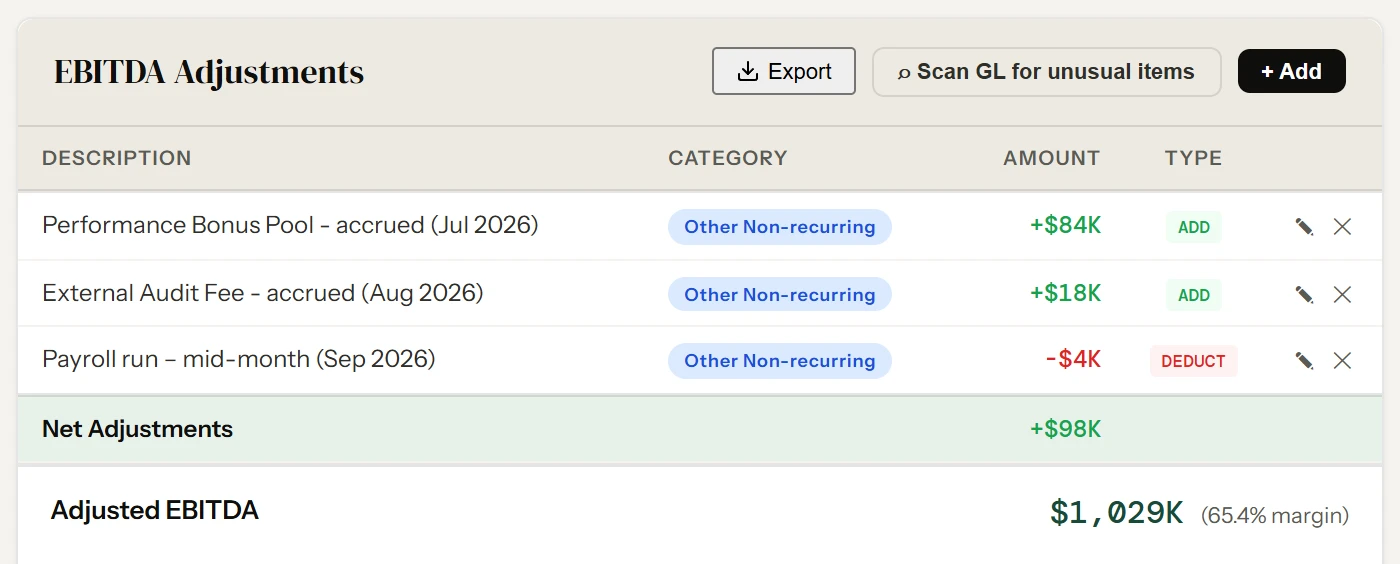
Fynease Quality of Earnings, EBITDA adjustments: three items found by scanning the general ledger for unusual months. Performance Bonus Pool accrued July 2026, add-back 84K; External Audit Fee accrued August 2026, add-back 18K; mid-month payroll run September 2026, deduction 4K. Net adjustments plus 98K; adjusted EBITDA 1,029K at a 65.4 percent margin

Quality of Earnings · adjustments found by scanning the ledger, each one reviewed before it counts · Demo data
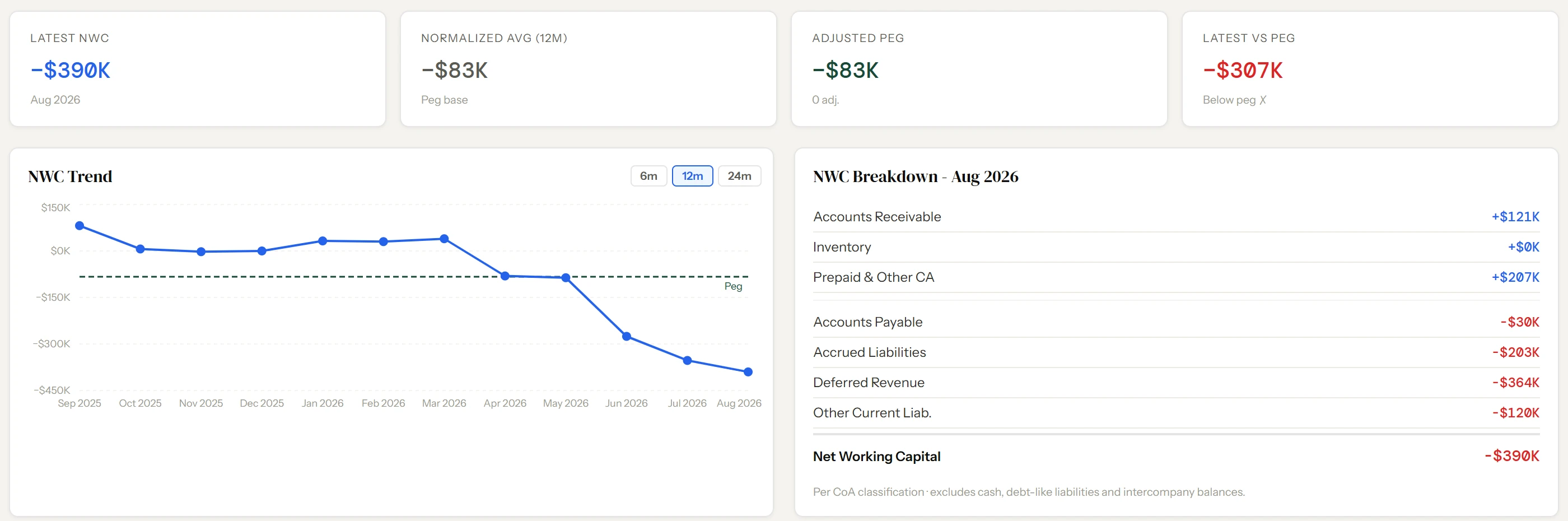
Fynease working capital peg: latest net working capital, the normalized 12-month average used as the peg, the adjusted peg and the latest against the peg, a 12-month net working capital trend against the peg line, and the net working capital breakdown by receivables, prepaids, payables, accrued liabilities, deferred revenue and other current liabilities

Working capital peg · from the same reconciled balance sheet you sign off each month · Demo data

01

Quality of Earnings

Assess the sustainability and defensibility of reported profitability. Built on your adjusted trial balance, not a spreadsheet someone assembled the week before due diligence.

  • Revenue quality classification: recurring vs one-time
  • Non-recurring expense identification
  • Normalized EBITDA bridge
  • TTM EBITDA calculation from clean ledger
  • Adjustments documented with source reference
  • QoE summary output formatted for review with your advisers
02

DCF and Business Valuation

Discounted cash flow and multiple-based valuation with scenario modeling. Assumptions are anchored to actual financial performance, not estimates you entered manually.

  • DCF with configurable discount rate and terminal value
  • Multiple-based valuation: EV/EBITDA, EV/Revenue
  • Base, upside, and downside scenarios
  • Sensitivity analysis on key assumptions
  • Revenue and EBITDA inputs from adjusted ledger
  • Valuation summary with assumptions and sensitivities disclosed
03

Working Capital Peg

The agreed working capital level a seller must deliver at close. Calculated automatically from your Balance Sheet reconciliation: on audit-ready numbers, not a snapshot taken the week before signing.

  • TTM average working capital calculation
  • Pulls from Balance Sheet reconciliation data
  • AR, AP, inventory, accrued liabilities, all sourced from close
  • Normalized working capital with adjustments
  • Peg presentation for purchase agreement
  • Variance analysis vs actual at close

Most QoE engagements start with two weeks of cleaning up the books.
Yours already are.

By the time a term sheet arrives, you have been briefing this client's management every month for two years from the same reconciled data. The revenue quality signals, the EBITDA trend, the working capital behavior: all already tracked. A buyer's accountant will spend the first week of due diligence reconciling the Balance Sheet and questioning the revenue numbers. If you have been running Automate, those answers are already documented, timestamped, and traceable to source. You are not defending your numbers. You are explaining your adjustments.

The close data is already clean

Fynease Automate has been running prepaid, depreciation, and loan schedules, reconciling the Balance Sheet, and posting entity-level adjusting entries for months before the term sheet arrives. The QoE starts on a clean ledger, not a raw QuickBooks export.

Every assumption is traceable

Every number in the analysis traces back to the adjusted ledger: an adjusting entry with a source, a timestamp, and a user. When a buyer's accountant asks where a number in the books came from, you open the lead sheet.

Working capital from reconciled balances

The working capital peg pulls from your Balance Sheet reconciliation data, the same reconciliation you signed off on every month. It is not a snapshot pulled the week before signing. The peg itself is still negotiated; this is the reconciled starting point.

Your judgment on normalization

EBITDA normalization requires a judgment call no software can make for you. You need to decide which items are genuinely non-recurring. That is where your expertise as an advisor sits. Fynease prepares the reconciled data around that judgment.

EBITDA normalization still requires your judgment.

Fynease builds the foundation: adjusted ledger, clean trial balance, reconciled Balance Sheet. You decide which revenue items are truly recurring and which expenses are genuinely one-time. That judgment is not a gap in the software. It is the reason your client hired you instead of a calculator. Fynease gives you the cleanest possible starting point so that judgment is fast, defensible, and documented.

How advisory relationships deepen over time.

Valuation is not a separate product you randomly buy. It is the natural evolution of an advisory engagement, built on the clean data you have been accumulating since month one.

First close
Automate the close
Connect QuickBooks Online. Set up schedules, intercompany rules, and consolidation structure once. Run a clean, traceable close.
Automate
Same month
Full CFO intelligence
The briefing, KPIs, PVM, revenue attribution and the 13-week cash view run from that first close. The first board pack goes out the same week. Your client sees the difference.
Intelligence
Every month
The record compounds
Each close adds a reconciled, signed-off month. Forecasts learn from the actuals, and the analysis a buyer's advisers would build from scratch is already on file.
Intelligence
Term sheet
Transaction readiness
Client gets a term sheet. You open the Valuation module. QoE, DCF, and working capital peg, built on every reconciled month you have closed. Days, not weeks. You are ready.
Valuation
Exit
The presentation is already built
Every number is traceable to the adjusted ledger. Every assumption is documented. The buyer's accountant asks questions. You answer them the same day.
Valuation

Common questions

Does Fynease Valuation require Fynease Automate?

Yes. The power of Fynease Valuation comes from the fact that the underlying accounting data is already clean. The QoE, DCF, and working capital peg all pull from your Automate-adjusted ledger. Without Automate running the close, the valuation module would need manual inputs, which defeats the differentiator entirely.

How quickly can I prepare for a transaction?

If you have been running Automate, the working capital and DCF inputs are already populated from reconciled books. QoE analysis still needs your review, because EBITDA normalization is a judgment call. Because the inputs are already reconciled, a first internal read on quality of earnings, value and the peg takes days rather than the weeks usually spent cleaning up the books first. It prepares you for the formal work; it is not a transaction package for third parties.

Is Valuation included in the base plan?

No. Valuation is a per-client add-on at $249/client/month. It activates when a specific client is in a transaction process and deactivates when the engagement ends. You do not pay for it across your full roster, only on the clients who need it.

What does the QoE output look like?

The QoE output includes a normalized EBITDA bridge, revenue quality classification, non-recurring item schedule, and adjustments documented with source references from the adjusted ledger. It is an internal working analysis for you and your advisers to prepare with, not a report to hand to a buyer, a lender, or an investor.

What is quality of earnings analysis?

Quality of earnings (QoE) analysis normalizes a company's EBITDA by identifying non-recurring, unusual, or unsustainable revenue and expense items. It gives a buyer confidence that reported profitability reflects the ongoing business. Fynease builds the QoE on your Automate-adjusted ledger, so the starting point is already clean and reconciled rather than raw QuickBooks data.

What is a working capital peg?

A working capital peg is the agreed level of net working capital a seller must deliver at close of a transaction. It is typically based on a trailing 12-month average of normalized working capital. Fynease calculates the peg automatically from your Balance Sheet reconciliation data, the same data used for your monthly close.

How is Fynease Valuation different from other valuation tools?

Many valuation tools start with manual inputs: you enter revenue, EBITDA, and growth assumptions yourself. Fynease starts with your actual accounting data. The adjusted ledger from Fynease Automate flows directly into the valuation model. The DCF and working capital peg pull from real, reconciled numbers, not estimates. EBITDA normalization is the one step where your advisory judgment is still required. Fynease handles everything else.

Does Fynease Valuation automate EBITDA normalization?

EBITDA normalization requires judgment that no software can fully automate: you need to assess which items are genuinely non-recurring versus just unusual. That judgment is where your expertise as an advisor adds value. Fynease provides the clean, period-accurate ledger as the foundation. You apply the normalization. The result is a defensible QoE built on audit-ready data.

Your client gets a term sheet.
You are already ready.

Start your free 14-day trial. Valuation is available as an add-on on any paid plan.

Start free trial