Fynease vs Fathom

The close layer vs
the reporting layer.

Fathom is a mature reporting, forecasting, and consolidation tool owned by The Access Group. It imports account totals from QuickBooks Online once a day and never changes the ledger. Fynease runs the close first, posts approved entries back to QuickBooks Online, then reports. One sits upstream of the other.

When to use which

Honest answer

Use Fathom when:

  • Your clients’ books are closed and reconciled somewhere else and you only need reporting, KPIs, and forecasts on top
  • Your roster is spread across Xero, MYOB, Sage, and QuickBooks and you want native daily sync to all of them
  • Three-way forecasting to three years, with scenarios and rolling forecasts, is your primary deliverable
  • You want to rank companies against each other within your own client group
  • Per-company pricing suits a roster of simple single-entity clients

Use Fynease when:

  • Your close still has prepaid or depreciation schedules, allocations, or intercompany work living in Excel
  • You manage multiple QuickBooks Online companies or non-QuickBooks entities that need a controlled consolidation
  • You need every Balance Sheet account reconciled and signed off inside the close, with lead sheets for the auditor
  • You want approved adjusting entries written back to QuickBooks Online rather than held in a reporting tool
  • You want the briefing produced from transaction-level, reconciled data rather than daily account totals

Try it on your own QuickBooks Online company. 14-day free trial, no credit card required.

Start free trial See pricing
The fundamental difference

Fathom reads what QuickBooks Online says.
Fynease changes what QuickBooks Online says.

If your books have prepaids that have not been amortized, intercompany balances that do not agree, or Balance Sheet accounts nobody has signed off, Fathom will report those numbers faithfully; its own help center notes that adjustments made in Fathom stay in Fathom. Fynease corrects them in the ledger first, and the briefing, forecasts, and board pack are built from the corrected books.

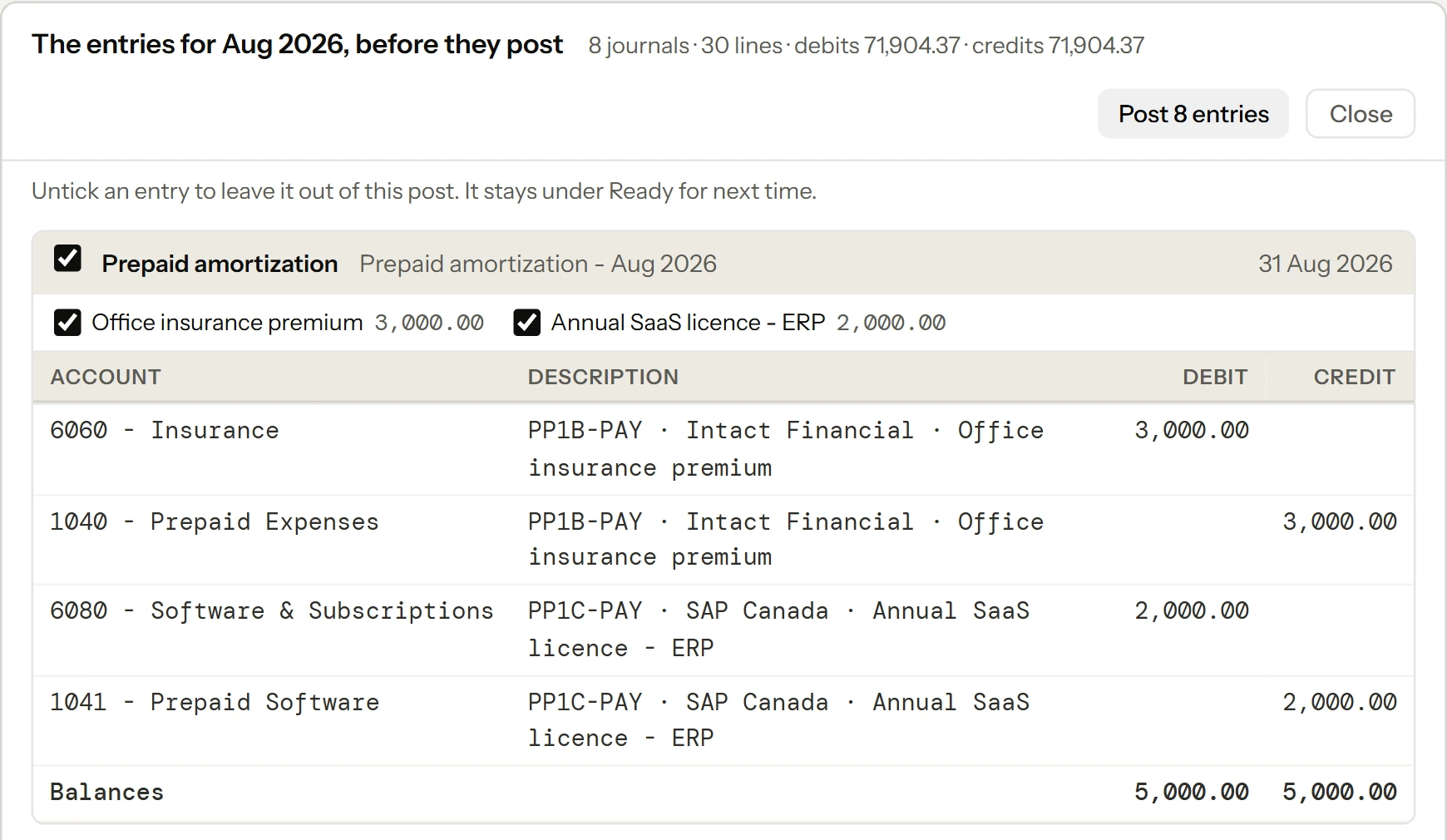
Fynease draft journal for August 2026, before it posts: prepaid amortization debiting 6060 Insurance 3,000.00 and 6080 Software and Subscriptions 2,000.00, crediting 1040 Prepaid Expenses 3,000.00 and 1041 Prepaid Software 2,000.00, each line naming the supplier and schedule, with a Post 8 entries button

The draft journal Fynease posts back to QuickBooks Online, each line naming its supplier and schedule · Demo data

What each tool does

Fathom capabilities and prices are taken from Fathom’s published website and help documentation as of September 2026. “Not described” means we could not find the capability documented; it is not a claim that it cannot be done.

Sources, checked September 2026: Pricing · The Access Group acquires Fathom · Daily automatic updates · Consolidated reporting · Multi-currency consolidation method · Forecast horizon · AR and AP import · QuickBooks Online import

Feature Fynease Fathom
Prepaid, deferred revenue, and depreciation schedules
Runs the schedule and posts the journal entry
YesNo
Forecast-only journals; presentation adjustments stay in Fathom
Loan and lease schedules
Loan amortization, IFRS 16 / ASC 842 lease schedules, posted to the ledger
YesNo
Loan and depreciation schedules exist only inside forecasts; nothing is posted
Cost allocations between accounts, classes, or entitiesYesNo
Intercompany transaction management
Chargebacks, recurring intercompany templates, correcting entries posted to each entity
YesNo
Intercompany reconciliation and eliminationYes: reconciles, then eliminatesElimination only
Whole-account or fixed-value eliminations; no reconciliation step
Multi-entity consolidationYes: QuickBooks Online + CSV/Excel entitiesYes: up to 300 entities
Across QuickBooks, Xero, MYOB, Sage, and Excel companies
Foreign currency translationYes: IAS 21, CTA posted to OCIYes: 97 currencies
Average rate P&L, closing rate Balance Sheet; translation difference shown as a reconciling note
Balance Sheet reconciliation and sign-offYes: every account, three-stage sign-off, timestampedNo
Adjusting entry write-back to QuickBooks OnlineYes: one click after approvalNo
One-way sync into Fathom only
Audit-ready lead sheetsYesNo
Depth of QuickBooks Online dataTransaction-level general ledgerAccount totals only
No general-ledger transactions; AR and AP invoices only, on Pro; up to 80 classes/locations; refreshed daily
Ledger connectionsQuickBooks Online natively; any other system via trial balance or GL import (CSV/Excel)QuickBooks Online and Desktop, Xero, MYOB, Sage Business Cloud (UK), FreeAgent, Excel, Google Sheets
Variance and driver analysisYes: bridges that reconcile by constructionYes: actual vs budget, target, prior period
KPI dashboardsYesYes: strong
50+ financial KPIs, custom formulas, non-financial KPIs, alerts
ForecastingYes: three statements over three or five fiscal years, scenarios, 13-week cashYes: strong
Three-way, up to 5 years beyond the current financial year on Pro, scenarios, rolling, consolidated
13-week cash flow forecastYes
Weekly grain, AR aging overlay with collection timing, scheduled loan and lease payments, forecast low point shown with its date
Monthly cash flow forecast
Three-way, indirect method, up to 5 years on Pro; a weekly 13-week view is not described
Management commentaryDeterministic briefing
Every sentence derived from the ledger; no language model
AI Commentary Writer
Generated commentary on Pro reports; attribution traces figures
Board and management report packsYes: briefing plus board pack composerYes
Template library, white-label, scheduled delivery
Revenue and gross margin attribution by customerYesNo
Customer-level data is not imported
BenchmarkingCurated benchmark bands, labeled with vintage and sourceGroup benchmarking
Ranks companies within your own portfolio; no external dataset described
Client accessAnalysis access for client management
Client management can be given access to Analysis (the analysis and briefing screens) for their company; there is no separate client portal
View-only client roles
Unlimited users
Quality of earnings and valuationValuation add-on: $249/client/month
Quality of earnings, normalized EBITDA, and working capital peg; indicative, for internal planning
No
Price-volume-mix analysisYes: price, volume, and mix by item and by customer, against the prior yearNo
Account totals only; no item or customer data
Quality of revenue scoringYes: recurring revenue, concentration, retention, and a quality of revenue scoreNo
Receivables and payables analysisYes
AR quality analysis and scoring with aging overlay; AR and AP tied to aging sub-ledgers in the close; AR and AP movement in the cash bridge
Aged AR and AP on Pro
QuickBooks Online and Xero invoices, payments and customer and supplier names; not for consolidated groups
Customer and product profitabilityYes
Contribution margin by customer, product, segment, or business unit every close; revenue and gross margin attribution by customer
Divisional only
By class or location (up to 80); no customer or product data imported
OwnershipIndependent, CanadaThe Access Group (UK), since 2022
Pricing (published)From $199/month; 1 client, 3 entities, Automate and Intelligence included (Valuation is a per-client add-on); 14-day free trialFathom Pro from $59/month per company (USD); Portfolio for firms from $67/month for 100 companies; unlimited users; 14-day free trial

Common questions

What is the difference between Fynease and Fathom?

Fathom is a reporting, forecasting, and consolidation tool that imports account totals from QuickBooks Online and other ledgers and turns them into dashboards, KPIs, forecasts, and consolidated reports. It does not change the ledger. Fynease is a close platform: it runs prepaid, deferred revenue, and depreciation schedules, reconciles intercompany balances and Balance Sheet accounts, consolidates, writes approved entity-level entries back to QuickBooks Online, and then produces the management briefing from that reconciled data. Fathom starts at the reporting layer. Fynease starts at the close.

Does Fynease replace Fathom?

For a QuickBooks Online practice or finance team, usually yes. Fynease includes the reporting Fathom would otherwise provide, including variance analysis, forecasting, KPIs, and board packs, and builds it on close-verified, transaction-level data. Fathom keeps an edge where the roster runs on Xero, MYOB, or Sage with native sync, where three-year three-way forecasting is the main deliverable, or where you want to benchmark clients against each other. If your books are already clean and those are your needs, Fathom is a good tool.

Can Fathom consolidate multiple entities?

Yes. Fathom consolidates up to 300 entities across QuickBooks, Xero, MYOB, Sage, and Excel companies, supports intercompany eliminations, and translates 97 currencies at average and closing rates. The difference is what happens before consolidation. Fynease reconciles intercompany balances across entities and flags mismatches before any elimination runs, applies IAS 21 with the translation adjustment posted to OCI, and consolidates entity books that have already been signed off account by account. Fathom consolidates the books as it finds them.

How does Fynease pricing compare to Fathom?

Fathom prices per company: Fathom Pro from $59 per month for one company, and the Portfolio tier for firms from $67 per month for 100 companies, with unlimited users. Fynease prices by client and entity capacity, from $199 per month for one client and three entities, and every plan includes the full close layer and the full Intelligence layer. Both offer a 14-day free trial. Prices are as published in September 2026 and can change.

Most QuickBooks reporting tools start at the dashboard.
Fynease starts at the close.

If your books need transformation before they can be reported on, Fynease is the right starting point. The reporting follows from the close, not the other way around.

Start free trial