Replace QuickBooks Online,
or add a layer on top?
As a company grows into several entities, the close, the consolidation and the reporting often outgrow QuickBooks Online before the bookkeeping does. There are two answers: replace the ledger with an ERP, including the newer AI-native ones, or keep QuickBooks Online as the book of record and add a finance layer on top of it.
What an ERP changes
- The ledger moves: history is migrated or kept in the old file
- Bookkeepers learn a new system; bank feeds, payroll and connected apps are set up again
- Consolidation, close and reporting live inside the new system
- The move is a project with a cutover date
Where Fynease fits
- QuickBooks Online stays the book of record, with its bank feeds, apps and bookkeeping workflow unchanged
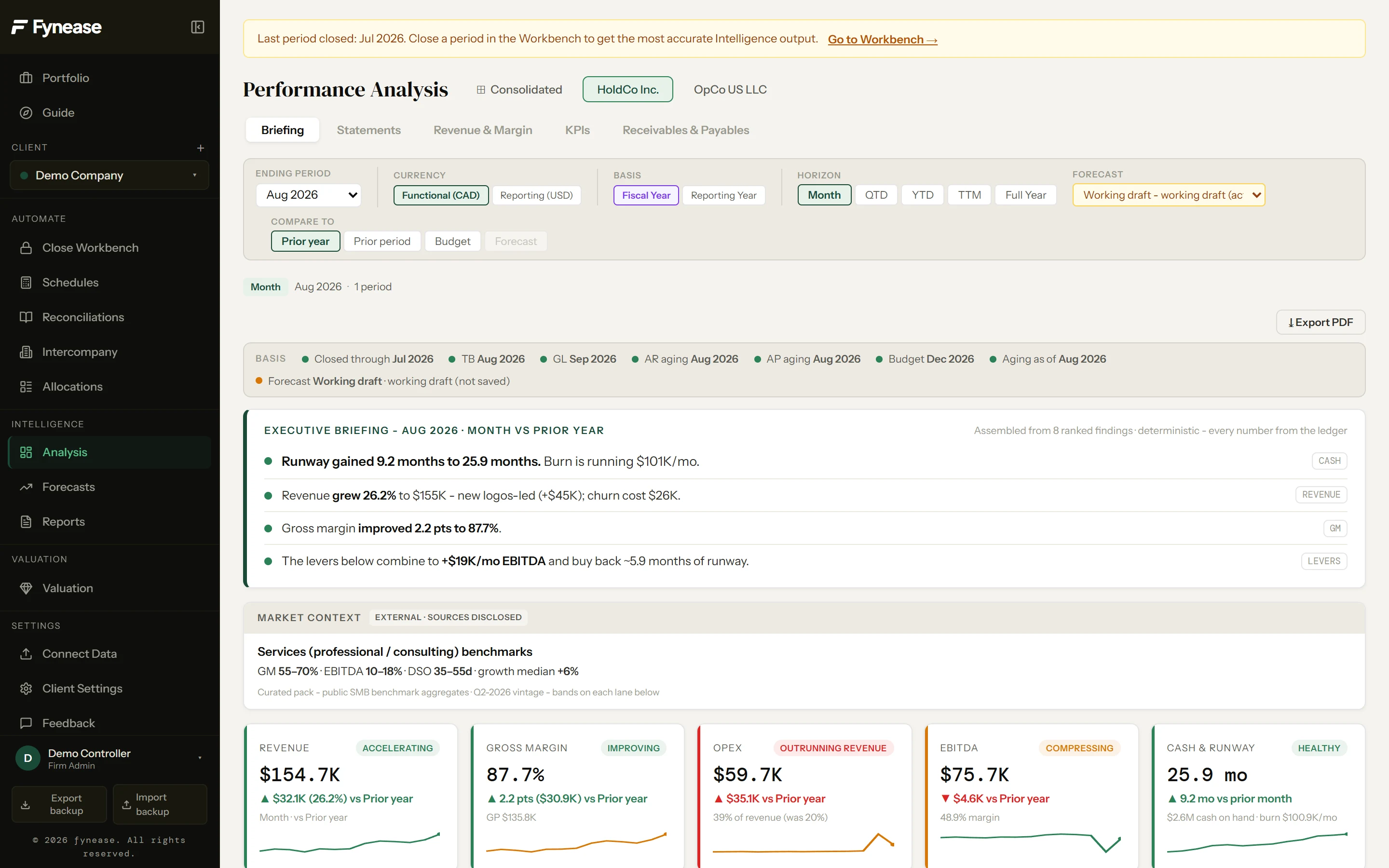
- Fynease adds the close, intercompany, consolidation and reporting across every company
- Entries post back to QuickBooks Online after approval, so the books stay complete
- Set up by connecting each company; nothing is migrated
Fynease on top of QuickBooks Online · the close, the analysis and the reports in one app · Demo data
When an ERP is the better answer
When the bookkeeping itself has outgrown QuickBooks Online, not just the close: transaction volume, inventory or revenue processes the ledger cannot hold, or a requirement from a lender, auditor or acquirer for a specific system. Then the ledger is the problem, and replacing it is the fix.
AI-native ERPs are one option; LiveFlow’s Flow, for example, replaces QuickBooks Online outright rather than reporting on it. LiveFlow is compared with the reporting tools.
When a layer on QuickBooks Online is the better answer
When the bookkeeping works and the pain starts after it: schedules kept in spreadsheets, intercompany that does not agree, a consolidation rebuilt every month, and reporting that waits for all of it. Those are close and reporting problems, and a finance layer solves them without moving the ledger or retraining the team.